AI Agents in Research Management: From Pilots to Production
14.01.2027

About
AI agents are already being used across the research management lifecycle, from scanning funding landscapes and supporting grant writing, to automating compliance checks and surfacing strategic insights from institutional data.
But for most research management teams, the challenge in 2027 is no longer whether to engage with AI: it is how to move beyond isolated pilots and embed AI tools into workflows that actually hold up under real conditions.
But for most research management teams, the challenge in 2027 is no longer whether to engage with AI: it is how to move beyond isolated pilots and embed AI tools into workflows that actually hold up under real conditions.
Learn how to take AI agents from pilot to everyday deployment using a practical roadmap developed at AI LEARN, Norway’s national AI centre for human learning. The roadmap puts people and organisation first, and technology last.
It begins with individual roles and capabilities, and with the assumptions that shape which changes seem possible. It then looks at your organisation, using a visual mapping tool to show what your office delivers, to whom, and where roles overlap or leave gaps. Only after that does it turn to AI tools and agents.
Throughout, the question is less about how much work you can delegate and more about how your team keeps the expertise it needs to judge the results.
You’ll also have a simple test of whether a redesigned office stays in control: can it still evaluate the output, detect errors, and switch models or suppliers?
Key takeaways:
- Where AI agents are being used in research management today, and which uses are proven and which are still experimental
- What separates a successful pilot from a system ready for daily use
- How to assess your institution’s readiness across governance, data, infrastructure and skills
- How AI can support your workflows, from funding identification to post-award management and impact reporting
- What the EU AI Act means for institutions deploying AI tools in research management
- What the profession needs to get right so that AI supports research integrity and quality
Who should attend:
Research managers, grants managers and research office staff at universities, institutes and public research bodies, as well as heads of research support, R&I directors, and those working on Horizon Europe proposals, post-award administration or research strategy.
About the speaker:
About the speaker:
Dr Hiwa Målen is Research and Innovation Manager at AI LEARN, which is run jointly by the University of Bergen and NTNU, and a researcher at UiT The Arctic University of Norway. A Horizon Europe expert evaluator, Hiwa has helped secure around NOK 500 million in research funding, founded EARMA’s thematic group on research management and AI tools, and has trained about 5,000 researchers in the responsible use of generative AI.
Questions? Contact us at events@crowdhelix.com
Date & Time
14 January, 2027 at 11 am CET (10 am GMT)
Register Today
Speakers
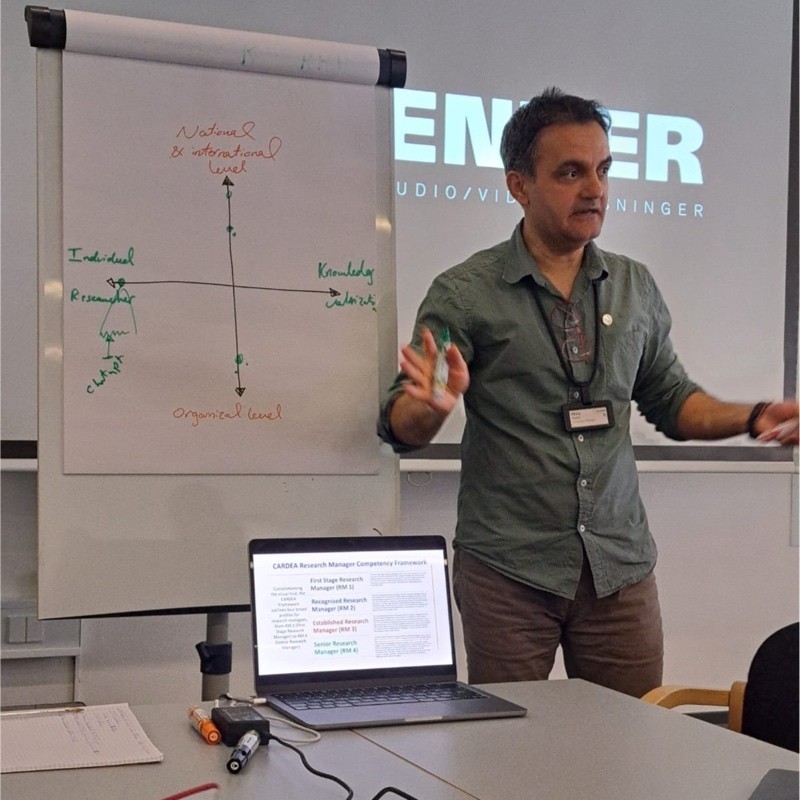
Hiwa Målen
Research and Innovation Manager at AI LEARN
Dr. Hiwa Målen is Research and Innovation Manager at AI LEARN, Norway's national AI centre for the empowerment of human learning, led jointly by the University of Bergen and NTNU. There he co-leads the centre's "maximising impact" cluster.
He is also a Researcher at UiT The Arctic University of Norway and a Horizon Europe expert evaluator for the European Commission.
He is also a Researcher at UiT The Arctic University of Norway and a Horizon Europe expert evaluator for the European Commission.
Hiwa has extensive experience across research, industry and research management. He holds a PhD in molecular biology from the University of Bergen and worked in project and risk management in the offshore energy sector.
Over the past four years, he has helped secure around NOK 500 million in research funding from national funders and from Horizon Europe, the EU's framework programme for research and innovation.
Over the past four years, he has helped secure around NOK 500 million in research funding from national funders and from Horizon Europe, the EU's framework programme for research and innovation.
He founded EARMA's thematic group on Research Management and AI Tools and coordinates NARMA's national capacity-building programme for research managers.
On behalf of the Norwegian Ministry of Education and Research, he serves as Norway's national expert on research management in the European Research Area (ERA) policy agenda. He has trained about 5,000 researchers and research professionals in Norway and across Europe in the practical, responsible use of generative AI.
On behalf of the Norwegian Ministry of Education and Research, he serves as Norway's national expert on research management in the European Research Area (ERA) policy agenda. He has trained about 5,000 researchers and research professionals in Norway and across Europe in the practical, responsible use of generative AI.
His work is guided by inclusiveness, a commitment to creating impact, and a vision of responsible human–AI interaction and hybrid intelligence, in which AI strengthens rather than replaces human judgement.
